
Fintech KYB Is a Control System, Not an Onboarding Form
Fintech growth creates more than onboarding volume. It introduces new products, markets, customer types and risk combinations. Learn how fintech teams can scale KYB without fragmenting their controls.
The first KYB workflow usually works.
It was designed for one product, one market and a reasonably clear customer profile. The fintech knows which businesses it wants to serve, what evidence it needs and which cases require additional review.
Then the business changes.
A new product introduces different eligibility rules. A new market requires different evidence. A partner channel brings its own approval conditions. A new customer segment produces ownership structures the original journey was never designed to handle.
The fintech is still onboarding businesses, but it is no longer solving the same control problem.
This is where KYB for fintech teams often starts to fragment.
The original workflow does not collapse overnight. It slowly collects copied processes, spreadsheets, one-off rules and exceptions remembered by individual analysts.
The problem is not simply more customers.
It is more combinations of products, markets, customer types and risks.
Growth creates control variation
A fintech onboarding thousands of similar local businesses through one product may have a simpler control problem than a fintech serving fewer businesses across several products and jurisdictions.
Each new dimension can change the onboarding requirements:
- Which businesses are eligible?
- Which evidence must be collected?
- Which data sources are reliable?
- Which risk factors matter?
- Which cases require enhanced review?
- Who can approve an exception?
- What needs to be monitored after onboarding?
The number of applications may grow gradually. The number of possible control combinations can grow much faster.
This is why small operational fixes become dangerous over time.
A new product copies an existing workflow. A country-specific requirement is added to a spreadsheet. A partner restriction is written into an analyst checklist. A risk threshold remains in application code until engineering can change it.
Each workaround solves today’s problem while making the overall control model harder to see.
The FCA has warned that customer risk assessments and financial-crime controls should develop alongside changes in products, services and customer types. Its 2025 review identified poor practice where firms expanded without first ensuring that their controls remained appropriate and effective. Read the FCA findings.
Growth is not separate from compliance design.
Growth changes the control problem.
Speed and control are not opposites
Fintech teams are often told they must balance fast onboarding against strong compliance.
That is usually the wrong framing.
Speed and control begin to look like opposites when every business is pushed through one rigid journey.
A straightforward local software company may be asked for evidence intended for a more complex business. Meanwhile, a company with layered ownership or cross-border activity may enter the same general queue and depend on an analyst noticing that the standard process is insufficient.
The result is awkward on both sides.
Low-risk businesses experience unnecessary friction. Complex cases receive inconsistent treatment. Analysts spend time navigating workarounds. Compliance becomes involved in decisions that should already be governed by clear policy.
A risk-based model works differently.
It applies proportionate requirements and directs human attention towards uncertainty. FATF notes that technology can improve the speed and effectiveness of AML/CFT processes when supported by appropriate governance and safeguards. Read the FATF report.
Speed does not come from removing controls.
It comes from applying the right control to the right case.
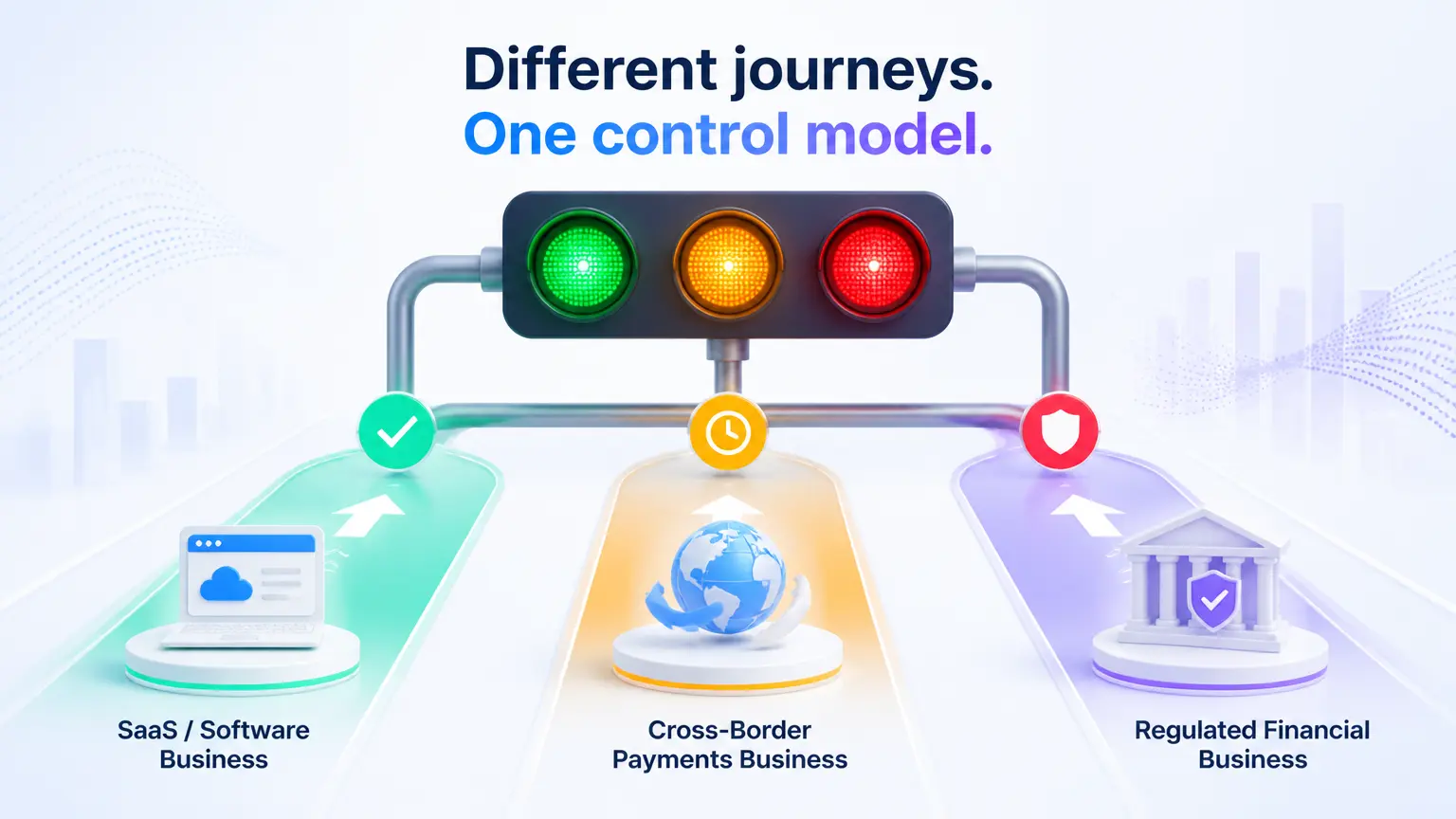
Different journeys, one control model
Consider two applicants.
The first is a local software company with simple ownership, reliable registry information and no material screening signals.
The second is a cross-border payments business with layered ownership, several operating jurisdictions and regulated activity.
They should not receive identical onboarding journeys.
The first may be resolved through standard evidence and lower-risk approval logic. The second may require licensing documents, deeper ownership analysis, enhanced due diligence and senior approval.
The workflows differ because the risks differ.
But both should connect to the same underlying control model:
- one representation of the business and its owners
- one approved policy framework
- one evidence structure
- one approach to risk assessment
- one controlled approval chain
- one decision history
A configurable KYB decision engine can apply different thresholds and routing rules without creating disconnected processes for every product or market.
The customer journey changes.
The control architecture remains coherent.
What the control layer needs to do
A scalable KYB control layer does not need to make every decision automatically. As explored in KYB Automation Is Not Auto-Approval, automation should structure the work without removing accountability.
For fintech teams, the control layer needs four capabilities.
1. Apply policy consistently
Evidence requirements, eligibility rules and approval thresholds should be defined clearly rather than scattered across code, spreadsheets and operational instructions.
Different journeys may use different rules, but those rules should still belong to one governed policy framework.
2. Route cases by risk
Complete, lower-risk cases should follow the appropriate standard route.
Missing evidence, ownership uncertainty, screening ambiguity or higher-risk exposure should trigger additional review. A configurable risk-scoring model can help teams apply those distinctions consistently and explain which factors affected the outcome.
3. Preserve the decision context
A final status is not enough.
The organisation should be able to see which evidence was reviewed, which policy applied, what risks were identified, who approved the case and why.
A connected KYB audit trail keeps the checks, sources, reviewer actions and rationale attached to the case rather than reconstructing them later from several systems.
4. Continue after onboarding
The company approved today may not remain the same company tomorrow.
Ownership, directors, corporate status, sanctions exposure and expected activity can change. Continuous KYB monitoring should connect material changes to the original customer record and trigger a new review when required.
The EU AML Regulation requires ongoing monitoring and risk-sensitive updating of customer information. It also requires firms to assess risks before launching new products, services, delivery channels or entering new customer segments and geographical areas. Read Regulation (EU) 2024/1624.
Seven questions before launching a new journey
Before launching a fintech product, entering a market or serving a new business segment, the team should be able to answer:
- Which businesses are eligible?
- Which information and evidence are required?
- Which sources will verify them?
- Which factors change the risk level?
- Which cases require enhanced review?
- Who can approve each type of exception?
- Which changes should trigger action after onboarding?
These questions should be answered before the journey goes live.
Otherwise, policy is likely to be assembled gradually through support tickets, analyst judgement and emergency spreadsheets, a little control-model patchwork quilt stitched during flight.
Fintech KYB should scale with the product
A fintech should not need to rebuild its KYB operating model every time it launches a product or enters a market.
The customer journeys can become more specialised.
The underlying controls should become more coherent.
That means treating KYB as a shared control system connecting eligibility, evidence, risk, approvals and monitoring, not merely as a form placed at the entrance to each product.
Straightforward businesses can move through the appropriate route. Material exceptions can reach the right reviewer. Policy can change without disappearing into code and institutional memory.
The fintech can move faster without asking compliance to surrender control.
Different journeys. One control model.